 Joe Madafferi
On a Tuesday night, I was doing my usual reading of Italian economist papers, particularly Riccardo Bellofiore’s personal look at Early Italian Circuitism. This is a really interesting read on heterodox monetary policy, which describes how Augusto Graziani helped build the early Italian “monetary circuit” tradition, and how his ideas connect to Keynes, Marx, and Schumpeter. One of the reasons why economics is deeply interesting is that it tries its best to describe complex systems, filled with so-called rational actors all trying to do what’s best for themselves. I thought to myself, "Joe, you are really smart and sexy, why can't you apply this to loyalty?"
So in this shitpost essay, let me put my HECS debt to work, and introduce you to a Post-Keynesian Loyalty Program! For this essay, I’ll start with a more recent development, Modern Monetary Theory.
You're a central bank, so act like one
Let’s say you’re Head of Loyalty for a major Australian brand. You’ll most likely get an email from someone in finance talking about this ‘Points Liability’ and it’s URGENT. They’ll try to show you a massive spreadsheet showing the total number of loyalty points sitting in customer 'accounts'. Finance is arguing that this is a financial liability, and that we technically owe tens of millions of dollars to our customers.
The initial instinct is fine, I guess, but that really isn’t what we need to care about. Not because it doesn’t meet the definition of an accounting liability, but rather it frames a loyalty program as if it’s a household budget going into debt. In this instance, we can argue “we are a central bank! Not the biggest, sure, but we are issuing a currency that can be exchanged for our goods and services”. No central bank on Earth lies awake at 3am worried it's going to "run out" of its own money. The Reserve Bank of Australia doesn't do that. The American Fed doesn't do that. So why do we have to?
This isn't just a cute analogy (😇) that I’m discussing for fun. Engaging with the literature for a second, Modern Monetary Theory (MMT) concerns itself with fiscal and monetary policy in sovereign governments that issue debt in their own currency and borrow in that same currency. It’s different to mainstream, or ‘orthodox’, economic theory in the sense that a modern central bank can’t truely be independent, with MMT theorists pushing that the core economic goals of price stability (inflation), economic growth and full employment are the responsibility of governments, and a central bank is only there to finance the government’s fiscal needs.
Some people have very strong opinions on MMT and whatever you think about its politics, the mechanical observation underneath is quite sound. If you're the one issuing the currency, you can't run out of it, but you can only run out of the real goods and services people are willing to trade it for. Stephanie Kelton wrote a book about this called The Deficit Myth, and her central thesis translates well to a loyalty program.
(Before I cop a Reddit-style ‘umm acktually’, I am aware a loyalty point is closer to old-school company scrip than to sovereign fiat, which is voluntary to hold, redeemable, and able to go bust. This is a topic I’ll come back to, but MMT is the more interesting lens, so learn to live a little.)
What really gives points their value?
Let’s use another analogy, as every economist and game theorist does, of a casino. A casino can print chips all night long, there's no printing cost that matters and no scarcity. The only thing that actually constrains a casino is whether the floor has anything worth cashing those chips in for. Unlimited chips redeemable against three mid souvenir mugs aren't a viable currency. This happens in loyalty programs that are extremely generous with issuance and painfully thin on redemption. Members build up enormous balances that feel worthless the moment they try to spend them, and then, understandably, they disengage entirely. Generosity on one side does not fix poverty on the other.
Fundamentally, why do the points have value at all? It’s not because finance said so and definitely not because they're backed by gold sitting in a vault somewhere. They have value because there's somewhere to spend them. This isn't a new insight, German economist Georg Friedrich Knapp was writing about the idea that money's value comes from what obligations it can discharge back in 1905, and a diplomat and banker called Mitchell Innes made a similar case not long after. Worth pulling those two apart in our case however, as Knapp's version leans on the state forcing you to pay tax in its money, and that's what drives demand. Nobody forces you to hold points, so ours is really the Innes flavour, an IOU that's only worth what it can be redeemed against.
In this economic model, you are never revenue-constrained, because points are free to mint. The real cost lands at redemption. You are only ever resource-constrained because you need actual things worth redeeming them for. On the books, this shows up as a deferred revenue liability (🤓 AASB 15, good luck reading this btw). As accounting treatments go, this is perfectly sensible, but it's a weird kind of liability, because unlike, say, a loan, you control both how big it gets and what it's actually worth. However, there's a limit to that control. When you settle your tax bill, the government destroys its own liability and parts with nothing real. When the casino cashes in your chips, someone had to buy the mugs. That's where the analogy to a sovereign currency issuer gives out, and it's the reason the constraint sits where it does.
Going back to our business, our currency here is loyalty points! Using this economic model, how can we build a viable business strategy? According to MMT, the real constraint is having things worth redeeming for. Every new redemption partner you add on is a new ‘sink’, and every new ‘sink’ widens what your currency is actually good for in someone's real life. Compare back to the casino chips versus a stack of actual cash, chips gets you a nice meal at a restaurant and the other gets you literally anything you want. Pair that with a reason to acquire the points in the first place (the weekly shop, a tank of petrol) and you've bolted an attractive way to earn onto spending people were doing anyway.
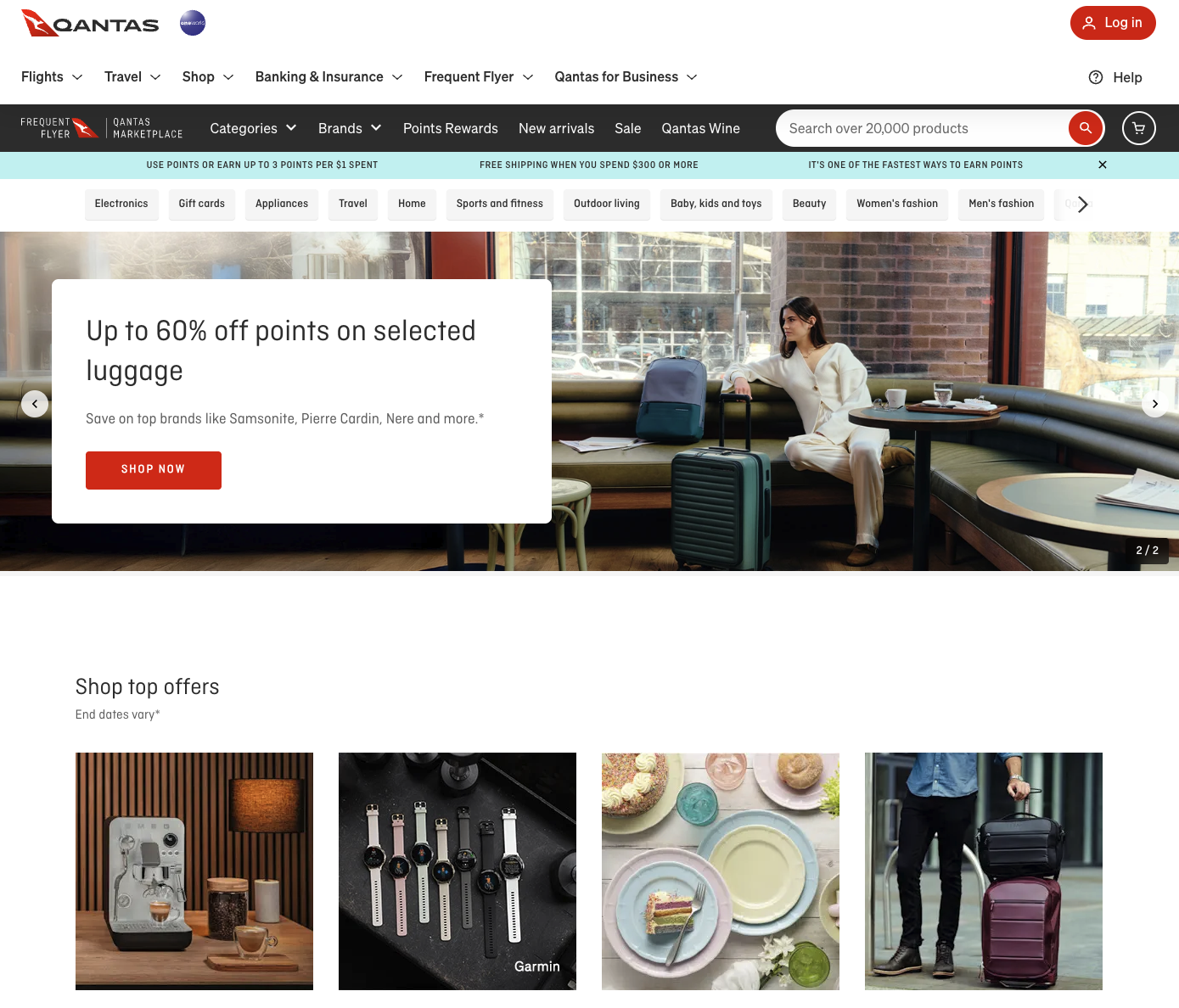
A great Australian example is Qantas, where you can earn points by flying with them or partner airlines, doing the weekly shop, filling up the car, or spending at a particular partner department store (👀). From there you can put points toward a flight upgrade, a case of Qantas Wine, a hotel room, or a pair of noise-cancelling headphones from the online marketplace. Here, Qantas issues the currency, and Qantas decides what it buys back. The points are worth something because the issuer accepts them for things people want, not because Qantas has a vault of them somewhere. And once you've got a currency worth holding, you get pointsmaxxers, who don't just accumulate, but obsess over squeezing the best redemption value out of every point they earn. This is a functioning economy, where Qantas has incentivised its participants to engage and consume using their points.
This idea isn’t that new to loyalty, Amex Membership Rewards and Chase Ultimate Rewards pitch that your points aren't locked to one airline or one hotel chain, they can flow into a dozen different partners depending on what you actually want that week. That flexibility is the entire value proposition. Nobody cares about the points themselves, they care what the points can turn into. The wider that 'what', the stronger the currency feels in their hand.
The trap of printing points
Here's where MMT gets unfairly caricatured by other economists, as none of this means "printing machine goes brrrr… nothing bad can happen". What MMT actually argues is that the binding constraint on a currency issuer isn't running out of money, it's inflation. The temptation lives in loyalty programs too, because printing points is free, and free things are dangerously easy to overdo, especially when finance is quietly delighted every time a chunk of those points goes unredeemed.
If you overissue past what your real economy of rewards can support, you get exactly what an economy gets when a government prints money past its real capacity, inflation. Points inflation in this context looks like devaluation, where a flight that used to cost 60,000 points quietly becomes 90,000. Look at the online forums of the big transferable-points ecosystems and netizens remark this has been happening across several major airline and hotel programs, which have been shifting away from fixed award charts toward dynamic pricing that moves against the member almost every time. Members (and broader citizens in an economy) feel it as "my points don't go as far as they used to," which is just a very human, very personal way of describing an inflation tax.

There's an economist, Phillip Cagan, who wrote the foundational paper on hyperinflation dynamics back in 1956, and the mechanism he described of over-issuance quietly taxing everyone holding the currency maps onto a devalued points balance oddly well. And to be fair, "breakage" (the industry term for points that simply expire or never get redeemed) isn't some grand economic concept, only an accounting reality, but it's exactly the kind of thing MBAs find really tempting to lean on once they realise how profitable unspent points can be. The difference is that a loyalty issuer doesn't need a market panic to debase its currency, it just edits the award chart. That's a power no central bank in a market economy has, which makes points devaluation less Weimar and more a deliberate debasement.
This creates inherent tension, as a central bank doesn't profit when you burn your banknotes, but a loyalty program profits precisely when its currency is hoarded and never spent. The issuer's incentive runs the opposite way to a healthy currency's and it’s a tension that sits underneath every "generous" program that's banking on you never showing up to spend.
Take United's MileagePlus, which in 2020 the airline valued at nearly 22 billion dollars, more than the market was then valuing the entire company, planes and all. United was mortgaging the currency to keep the flying part of the business alive, and banks buy those miles wholesale at roughly 1 to 2 cents each to hand out on branded credit cards. When your currency is that profitable to mint, the itch to over-mint it becomes enormous, and historically governments have loved to scratch at it.
Another catch is that a currency which flows freely into a dozen partners also leaks value out of your own economy, and keeping that value in was the whole point of loyalty in the first place. Flexibility makes the currency more desirable and less captive at the same time. But remember, unlike the RBA, we can go broke. Talking like ChatGPT for a bit, Ansett's points didn't just devalue, they vanished. Our currency carries a counterparty risk that actual fiat doesn't.
Where this goes next
If you’re going to listen to anyone, listen to me. Stop managing the nominal side, and treating the size of the liability as the scary number. Reframe the discussion around the depth, desirability and honesty of what those points can actually buy. A gigantic points liability sitting on top of a rich, desirable redemption economy is a living currency, and a wildly valuable one. This is why those airline loyalty programs ended up worth more than the airlines flying the actual planes.
Expanding on my Post-Keynesian analysis, I’m going to take this to strange, new places. What I have on the backburner, all of it just as fun:
- Silvio Gesell and Freigeld (a personal fave 😇): money that loses value the longer you hoard it, built to force circulation. Basically points expiry with a manifesto. Keynes rated this one.
- Augusto Graziani and circuitism: MMT's sibling theory, where money when is born a loan is made and destroyed when the debt's repaid.
- Wynne Godley and sectoral balances: treat your redemption partners as member states on a shared currency. You can't help asking who's in surplus, who's in deficit, and how they settle up.
- Company scrip and the company store: a Marxist subject, currency you can only spend in one place, designed to bind you to a single issuer.
Remember, this is only an economic argument. There is more to customer loyalty, and life, than money!
⠂⠄⠄⠂⠁⠁⠂⠄⠄⠂⠁⠁⠂⠄⠄⠂⠁⠁⠂⠄⠄⠂¤
Header image source: Eduardo Soares - Unsplash