 Nishant Jawa
Feature highlights
Operator learns to build a whole campaign
Up to this point, Operator could help you write a message. As of June 25, it can build the entire campaign around that message: targeting the right audience, scheduling delivery, and assigning conversion events, all from a natural-language prompt instead of clicking through each step yourself. Braze also folded its separate legacy AI tools (the Copywriter, the Liquid Agent, the Image generator, and a few others) into Operator, so there's one assistant to talk to instead of five.
Take an activewear brand launching a new hoodie drop. Instead of building a push campaign step by step, a marketer could tell Operator: "Create a push campaign targeting users who haven't purchased in the last 30 days, promoting our new hoodie drop with 20% off, scheduled to send tomorrow at 10am, with conversion tracked on purchase completion."
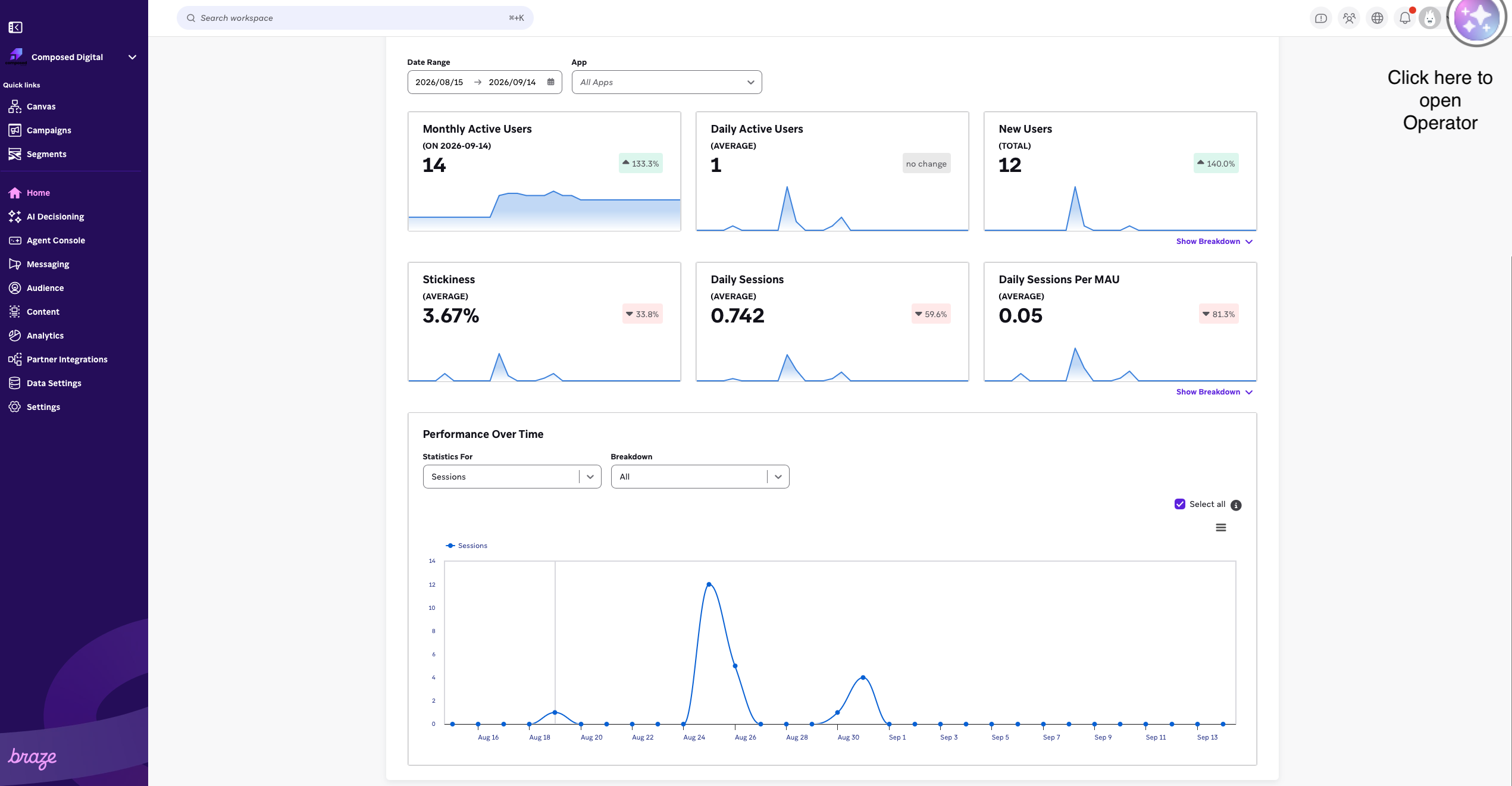
(Operator lives right next to your profile icon, top right of the dashboard.)
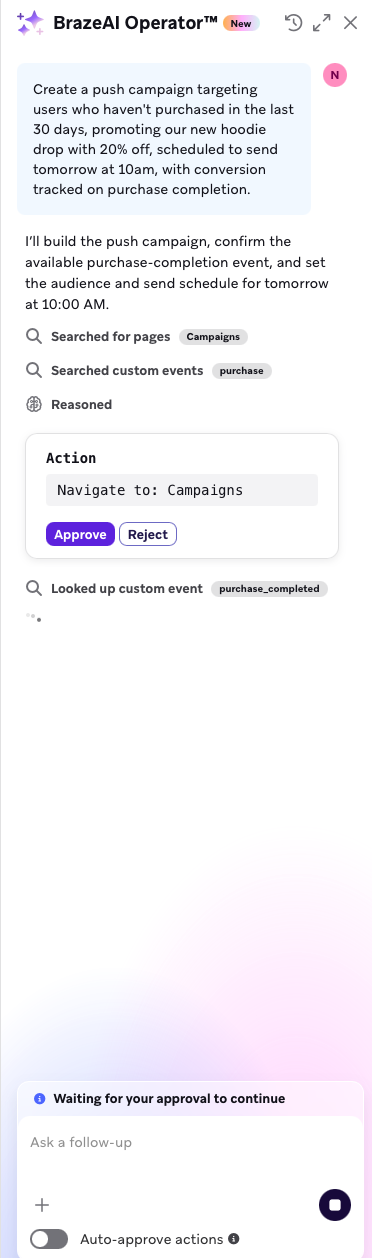
(Operator reasons through the request (checking your pages, your custom events) and stops to ask for approval before it acts. Nothing launches without you clicking through.)
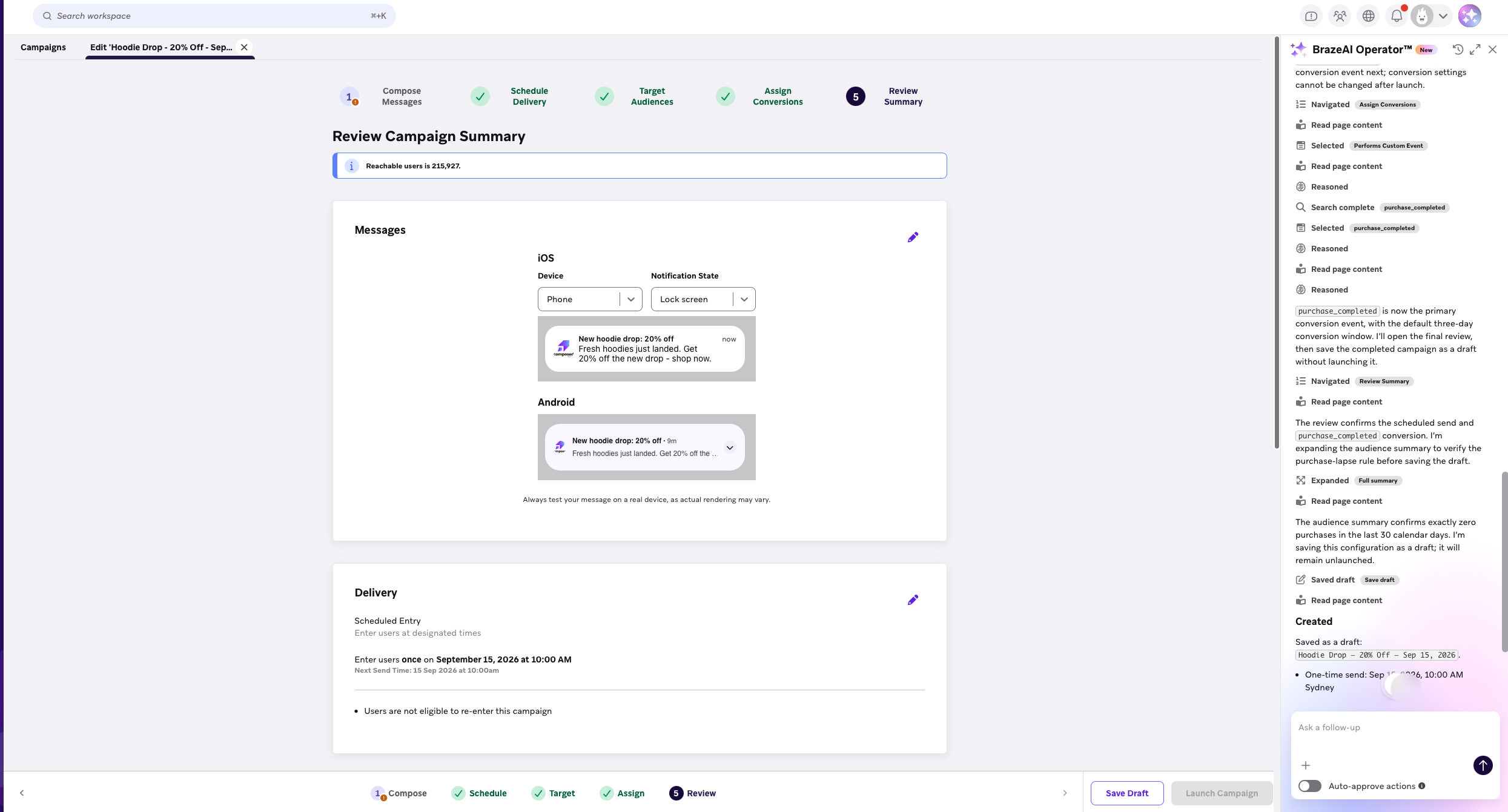
(Seconds later, there's a fully built campaign waiting for review: audience size, message previews for iOS and Android, and the scheduled send time, saved as a draft rather than launched automatically)
Braze opens up to outside AI tools
Here, the change isn't inside Operator, it's about what else can connect to Braze. Braze opened up an early-access way for external AI tools, including Claude, Gemini, ChatGPT, and Cursor, to connect directly to your Braze account. Once connected, those tools can look up your campaign, Canvas, and segment performance, plus custom attributes and KPIs, and even help build or update email templates and content, without ever seeing anyone's personal user information. So if your team already uses AI tools for other parts of the job, they can now plug straight into Braze too, instead of Braze being a separate system you have to jump into.
Operator can now build entire journeys
The biggest jump of the three. Operator can now draft a full Canvas, meaning a multi-step, multi-channel journey, from a plain-English description, and edit an existing one the same way.
Take that same activewear company, this time running a win-back journey for lapsed customers. A marketer could describe the whole thing to Operator in one prompt: "Create a Canvas for customers who haven't ordered in 30 days: send an email with a 20% off code right away, follow up with an SMS reminder 3 days later if they haven't redeemed it, then a final email 4 days after that with a last-chance message before the code expires, and track conversion on order completion."
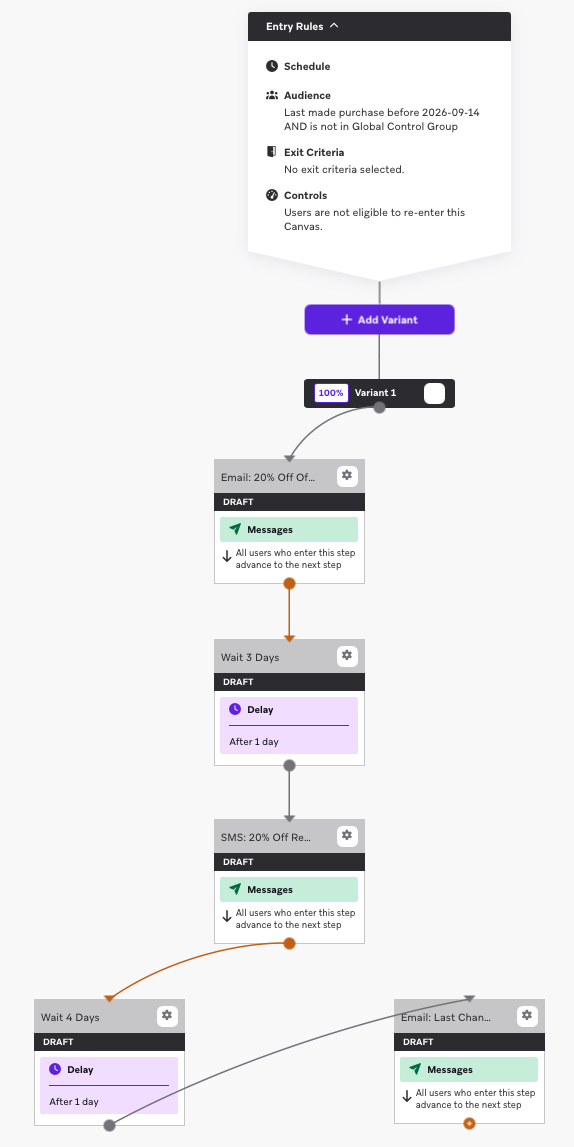
Operator lays out the full five-step flow (two emails and an SMS, with the wait steps between them) and is upfront about what it still needs before the draft can go live, in this case, the actual promo code and the event that tracks a redemption. It builds the structure immediately and flags exactly what a person needs to fill in, rather than guessing and getting it wrong.
Cloud Data Ingestion also picked up a SQL editor in this release, letting you build or edit a data sync by writing a query straight against your warehouse tables instead of maintaining a separate Braze-specific structure. While it does improve flexibility, it only accounts for about 10% of the complexity of configuring CDI in the first place. It doesn’t natively handle CDC and it also only allows a single-level select statement, meaning your complex data will still need to be carefully prepped upstream in your warehouse.
Closing
It’s clear that the AI boom has hit the Braze engineering team, as these releases are more frequent and more substantial than they ever have been. On the release page itself, Braze has bundled 200+ features in the past year alone.
This quarter, the throughline is clear: Operator is doing more of the actual building, from campaigns to entire journeys, and Braze is making it easier to plug in both your own data and your own AI tools. There's plenty we didn't cover here too, smaller updates across reporting, partnerships, and SDKs from each of these releases, but the Operator and CDI changes are the ones worth prioritising if you're planning what to tackle next.
We'll keep breaking down what's new from Braze as it lands, and what's actually worth acting on versus just noting. If you want to talk through any of this for your own setup, reach out.